Tag: Bareilly

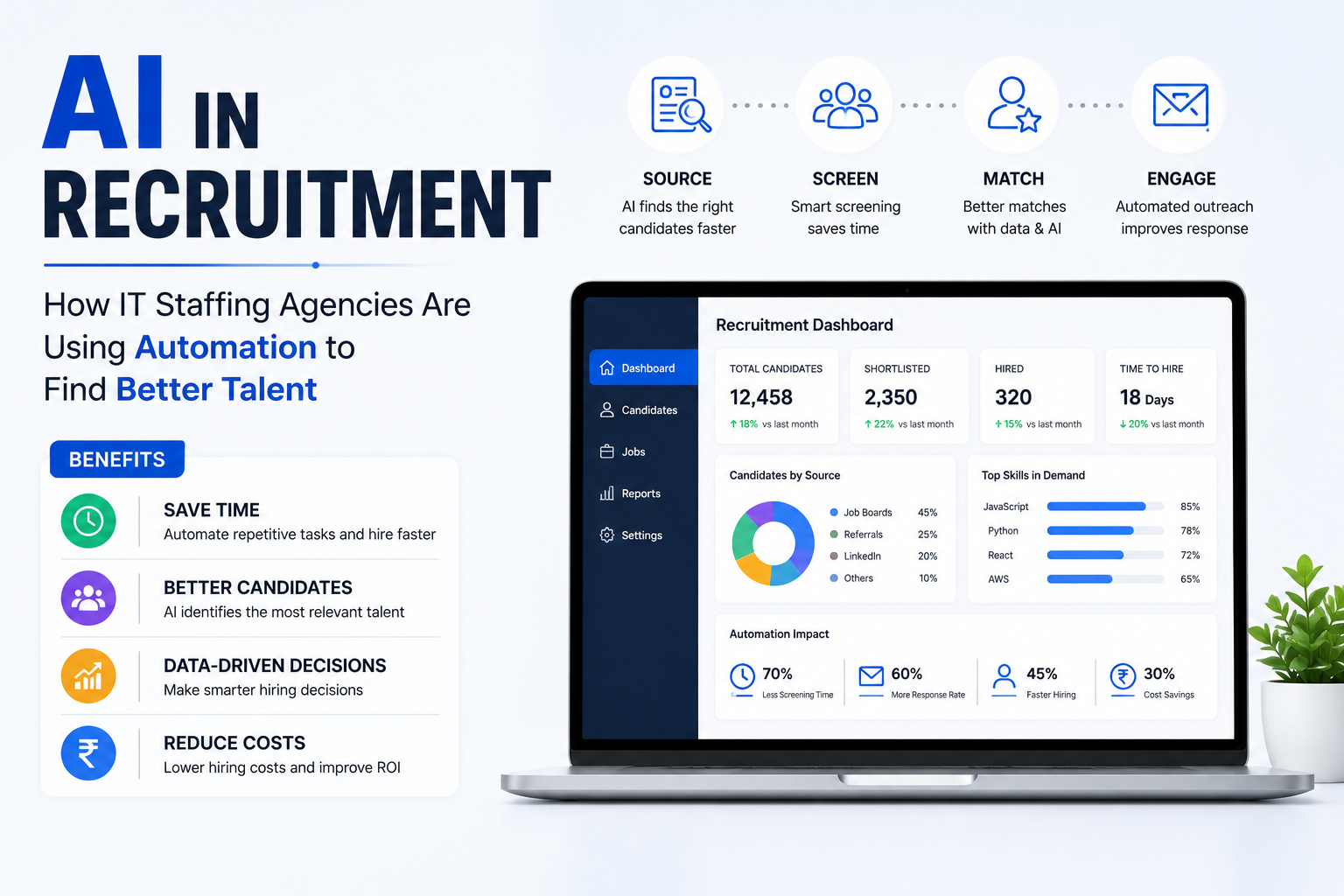
  • AI in Recruitment: How IT Staffing Agencies Are Using Automation to Find Better Talent

    AI in Recruitment: How IT Staffing Agencies Are Using Automation to Find Better Talent

    A recruiter at a Bengaluru IT staffing firm used to spend three days shortlisting 20 engineers from 400 applications. Now the same task takes four hours — and the shortlist is better. That’s not a hypothetical. That’s what AI in IT recruitment India looks like when it actually works, and in 2026, it’s working at scale.

    The automated hiring process 2026 isn’t just about speed. It’s about reducing the noise that buries good candidates, eliminating the bias that sinks fair ones, and giving hiring teams time to do the thing machines still can’t — build real human connections with the people they’re about to hire.

    India’s IT sector alone adds hundreds of thousands of jobs annually. The volume of applications is staggering. Without automation handling the first few layers of filtering, the whole process would collapse under its own weight.

    This post breaks down how IT staffing agencies are actually using AI right now — not the hype version, the real one.

    Why AI in IT Recruitment India Has Become a Necessity, Not a Trend

    Three years ago, an IT staffing agency using AI recruitment tools India had a genuine competitive edge. Today, agencies that aren’t using them are struggling to compete. The shift happened faster than most industry watchers predicted.

    India’s tech hiring market is uniquely demanding. The country produces over 1.5 million engineering graduates each year. Add career changers, upskilled professionals, and returning NRIs, and the talent pool is enormous — but so is the noise. Sorting through it manually isn’t just slow, it’s unreliable. Human screeners are inconsistent, influenced by irrelevant factors, and genuinely exhausted by volume. India’s leading IT companies recognized this early, and mid-size staffing agencies are now catching up fast.

    Then there’s the candidate experience problem. When someone applies for a role and hears nothing for three weeks, they’ve already accepted another offer. The automated hiring process 2026 solves that too — faster acknowledgment, faster screening, faster decisions. Speed is now a retention tool, not just an operational metric.

    What an Automated Hiring Process 2026 Actually Looks Like

    People imagine fully automated hiring as a conveyor belt where resumes go in one end and offers come out the other. The reality is more layered, more human, and more interesting.

    A typical automated hiring process 2026 at an Indian IT staffing agency runs roughly like this:

    • Resume parsing AI ingests applications, extracts structured data — skills, years of experience, tech stack, education, certifications — and normalizes it against job requirements.
    • Ranking algorithms score candidates against role criteria, surface the top matches, and flag anomalies like resume padding or inconsistent timelines.
    • Automated outreach sends acknowledgment messages, requests portfolio links, or books screening slots — all before a human recruiter has opened their laptop.
    • AI-assisted video screening in some agencies, pre-recorded video interviews are analyzed for communication clarity, technical vocabulary, and response coherence.
    • Recruiter review takes over from here. The AI narrows the field; humans make the call. That boundary is important.

    No well-run agency uses AI to make final hiring decisions. The best setups use it to protect human time — so when a recruiter does engage with a candidate, it’s meaningful.

    AI Recruitment Tools India: What the Market Is Actually Using

    AI recruitment tools India has grown into a full ecosystem. A few categories dominate what IT staffing agencies are deploying right now:

    Resume Parsing & Matching

    Resume parsing AI is the most widely adopted tool in the stack. Platforms like HireQuotient, Keka, and Darwinbox have built parsing engines tuned to Indian resumes — which differ structurally from Western formats. They handle vernacular formatting, abbreviated institute names, and inconsistent date notations better than generic global tools.

    Predictive Hiring Analytics

    Predictive hiring analytics goes a level deeper. Instead of just matching skills to requirements, it models which candidate profiles have historically performed well in similar roles — and uses that to score new applicants. When done with clean data, this dramatically improves first-year retention rates. The caveat: garbage data in, garbage predictions out.

    Generative AI for Job Descriptions and Candidate Summaries

    Generative AI staffing tools are changing how agencies create job descriptions and candidate briefing documents. Instead of copy-pasting from old JDs, recruiters now generate role-specific, keyword-optimized descriptions in minutes. Candidate summaries sent to clients are drafted by AI and reviewed by humans — cutting a 40-minute task down to 8.

    Smart Candidate Screening Chatbots

    Smart candidate screening via conversational AI has picked up significantly in 2025–26. Candidates interact with a chatbot that asks qualifying questions — availability, salary expectations, tech preferences, notice period — and only routes engaged, eligible candidates to human recruiters. Drop-off rates at this stage tell agencies a lot about how their JDs are resonating.

    Tech Hiring Automation: Where Bias Gets In and How to Catch It

    Tech hiring automation carries a risk that doesn’t get discussed enough in vendor brochures: it can systematize bias at scale. An algorithm trained on historical hiring data will replicate whatever patterns existed in that data — including the problematic ones.

    India-specific risks are real. Models trained on hiring data from Tier 1 cities may systematically underrate candidates from Nashik, Coimbatore, or Bhubaneswar who attended less well-known colleges. Models that weight certain tech buzzwords may favour candidates who’ve learned to keyword-stuff their resumes over those with deeper but less flashily-named experience.

    The answer isn’t to avoid AI in IT recruitment India — it’s to audit it regularly. Every three to six months, run a distribution analysis: who is your system surfacing, and who is it quietly burying? If your shortlists consistently over-represent candidates from a narrow set of colleges or cities, something in the model needs adjustment.

    Agencies that get this right — that treat their AI tools as systems requiring ongoing oversight, not set-and-forget installations — will build fairer and frankly stronger talent pipelines. Much like how management software platforms need regular audits and updates to stay effective, recruitment AI is no different.

    Predictive Hiring Analytics: Making Better Calls Before the Interview

    The most underused capability in the AI recruitment tools India market right now is predictive analytics. Most agencies have adopted parsing and matching. Far fewer have moved into genuine prediction — and the ones that have are seeing measurable results.

    Predictive hiring analytics uses historical outcomes — who stayed, who performed well, who left in three months — to build models that score new candidates on those same dimensions. It shifts the question from “does this person have the right skills?” to “is this person likely to succeed and stay in this role?”

    For IT staffing agencies in India, where client relationships depend on placement quality and retention rates, this distinction matters enormously. A candidate who looks great on paper and leaves in four months is a problem for everyone — the client, the candidate, and the agency. Predictive hiring analytics helps reduce that outcome when it’s used honestly and reviewed regularly.

    The data requirements are real, though. Smaller agencies with less historical placement data will struggle to build reliable models from scratch. Partnerships with platform providers — or pooled anonymized data models — are emerging as solutions. Just as state-level digital adoption benchmarks, like those documented in India’s ERP adoption guides, help organizations understand where to focus, benchmarking hiring outcomes helps agencies calibrate their own models.

    Generative AI Staffing: Where Things Are Getting Really Interesting

    Generative AI staffing is the newest layer on top of established automation, and it’s changing day-to-day recruiter workflows faster than any previous tool.

    In practice, it means: a recruiter describes a role in plain language, and the AI generates a complete, SEO-friendly job description in seconds. A candidate completes an initial screening, and the AI produces a structured briefing note for the client — highlighting strengths, flagging gaps, and summarizing the interview exchange. A hiring manager sends feedback, and the AI synthesizes it into actionable next steps for the recruiter. These used to be hour-long tasks. They’re now minutes. The cognitive load reduction is significant, and it compounds. Recruiters handling 30% more roles with the same attentiveness is not a small operational gain. Enterprise-grade platforms across industries have shown this same compounding effect when the right automation is applied to repetitive knowledge work.

    The key constraint on generative AI staffing right now is hallucination. AI-drafted candidate summaries can confidently include skills the candidate didn’t actually claim, or misattribute experience. Human review before anything goes to a client is non-negotiable. The tool accelerates; the human verifies.

    What IT Staffing Agencies Need to Watch Out For in 2026

    The automated hiring process 2026 comes with specific failure modes that agencies should understand before they go deep into AI adoption.

    Over-automation kills candidate experience. If every touchpoint is a bot, candidates feel processed, not considered. The agencies winning on employer brand are the ones that use AI to make human interactions faster and better-prepared — not to replace them entirely.

    Poor data hygiene breaks everything. Parsing AI is only as good as the data it’s fed. Old job descriptions, inconsistent role titles, and messy candidate databases produce garbage outputs that waste recruiter time and erode trust in the system.

    Vendor lock-in is a real risk. Several AI recruitment platforms offer deep integrations that make switching expensive. Agencies should evaluate portability of their data and models before signing long-term contracts with any single provider.

    Candidate privacy and consent are not optional. India’s Digital Personal Data Protection Act (DPDP Act) 2023 applies to recruitment data. Agencies running AI tools on candidate data need proper consent frameworks in place — not just a clause buried in an application form.

    Frequently Asked Questions

    What is AI in IT recruitment India and how is it being used?

    AI in IT recruitment India refers to using machine learning tools for resume parsing, candidate scoring, predictive analytics, and automated outreach. It’s being used by staffing agencies and in-house HR teams across Mumbai, Bengaluru, Hyderabad, and Pune to handle high-volume tech hiring more accurately.

    How does an automated hiring process 2026 differ from traditional hiring?

    Automated hiring process 2026 handles the first two to three filtering stages without human intervention — parsing, ranking, and initial outreach. Traditional hiring requires a recruiter to do all of that manually, which is slower and more prone to inconsistency. Humans still make final decisions in a well-designed system.

    Which AI recruitment tools India-based agencies are using most?

    AI recruitment tools India agencies commonly rely on include Keka, Darwinbox, HireQuotient, and integrations built on top of global platforms like Greenhouse or Lever. Resume parsing, chatbot screening, and predictive scoring are the three most adopted capabilities right now.

    What is resume parsing AI and why does it matter?

    Resume parsing AI converts unstructured resume data into clean, structured fields — skills, experience, education, certifications — that can be matched against job criteria at scale. It matters because manual data entry is the single biggest time drain in high-volume recruitment.

    Automation Won’t Replace Recruiters — But Recruiters Using It Will Replace Those Who Don’t

    AI in IT recruitment India has moved from a differentiator to a baseline expectation. Staffing agencies that have built AI into their core workflows aren’t just faster — they’re more accurate, more consistent, and more attractive to clients who’ve seen the difference in placement quality.

    None of this means the recruiter is becoming obsolete. The best outcomes consistently come from agencies where AI handles volume and humans handle judgment. Relationship-building, reading a room, knowing when a candidate is underselling themselves — these aren’t tasks that get automated in any near-term future. What gets automated is the grind that stops recruiters from getting to those moments in the first place.

    For IT staffing agencies building out their automated hiring process 2026 stack, the right technology infrastructure matters from the ground up. Platforms that connect your ATS, your client management system, and your AI tools into a coherent workflow — rather than a pile of disconnected subscriptions — are what separate agencies that scale from agencies that just get busier. That’s where working with experienced technology partners like eFox Technologies makes a practical difference, not just a theoretical one.

    The IT talent market isn’t slowing down. The volume isn’t shrinking. The agencies that will lead in 2026 and beyond are the ones building smarter systems now — and using those systems to make their people better, not redundant. Visit efoxtechnologies.com to see how the right digital infrastructure supports exactly that kind of growth.
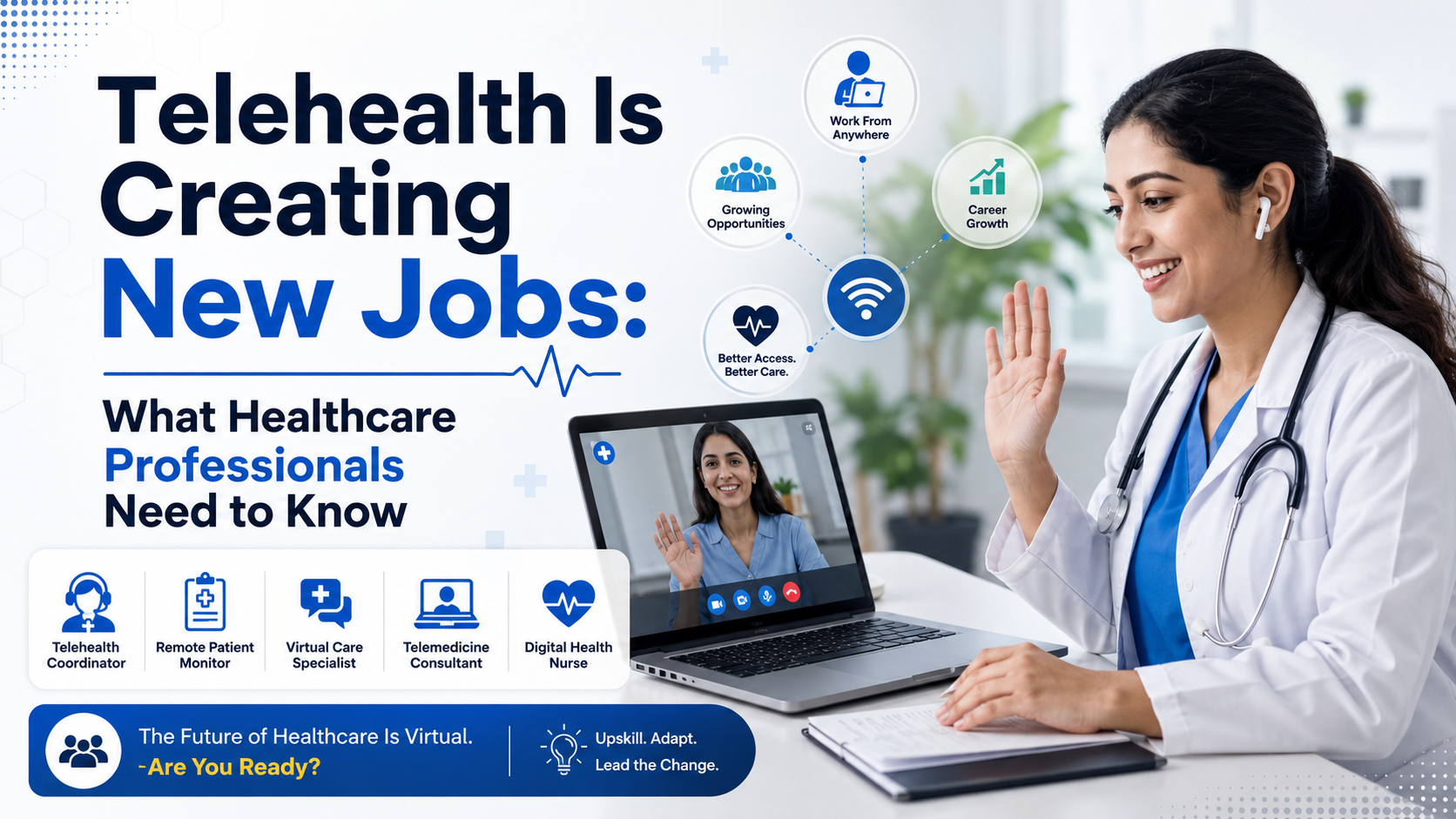
  • Telehealth Is Creating New Jobs: What Healthcare Professionals Need to Know

    Telehealth Is Creating New Jobs: What Healthcare Professionals Need to Know

    A radiologist in Jaipur reviews scans for a hospital in Kochi — without leaving his home. A nurse in Lucknow counsels patients in Bengaluru via video call, her shift ending before dinner. If you think these are outliers, think again. Telehealth jobs India 2026 is one of the fastest-growing segments in the entire employment market right now, and professionals who get in early are going to be very well-positioned.

    Digital healthcare recruitment has shifted from a trickle to a flood. Hospitals, insurance companies, and health-tech startups are all hiring — and hiring fast. The roles aren’t just for doctors either. Coordinators, coders, pharmacists, mental health counselors, and even administrative staff are discovering that their expertise translates directly into this new format.

    If you’re a healthcare professional wondering whether telehealth is for you, the honest answer is: probably yes. You just need to know where to look and what to expect.

    That’s exactly what this post covers.

    Why Telehealth Jobs India 2026 Are Growing So Fast

    The pandemic pushed telemedicine into mainstream use almost overnight. But the hiring boom of 2026 isn’t really about the pandemic anymore — it’s about what came after it.

    India’s National Digital Health Mission has been laying infrastructure across the country. States like Telangana, Maharashtra, and Tamil Nadu have expanded their digital health initiatives significantly. Private players have built platforms that need qualified staff to run them. Add the insurance sector’s pivot toward cashless and digital-first claims management, and you get an ecosystem hungry for talent. Companies building that digital backbone — much like how India’s leading IT companies have been driving enterprise software adoption — are reshaping how services are delivered.

    Digital healthcare recruitment postings in India grew by over 60% between 2024 and 2025. The trend into 2026 shows no signs of reversing. If anything, demand is getting more specialized — which means salaries are moving upward too.

    Types of Telehealth Jobs India 2026 Has Opened Up

    Telehealth jobs India 2026 is not a single job category — it’s an umbrella. Here’s what actually sits under it:

    Clinical Roles

    • Teleconsultation doctors — general physicians and specialists across all major disciplines
    • Virtual nurses and care coordinators managing patient follow-ups remotely
    • Remote physiotherapists conducting video-guided rehabilitation sessions
    • Online mental health counselors and licensed psychologists

    Non-Clinical Roles

    • Medical coders and billers working fully remote for hospital groups and platforms
    • Telehealth patient coordinators managing scheduling, follow-ups, and records
    • Digital health content writers, educators, and patient communication specialists
    • Technical support staff for healthcare apps and platforms

    Administrative and Strategic Roles

    • Telemedicine staffing managers overseeing distributed clinical teams
    • Health data analysts working with patient outcomes and platform metrics
    • Customer experience specialists for health apps and telehealth portals

    The non-clinical roles are often overlooked, but they make up a significant chunk of what companies are actively hiring for. A hospital platform without good support staff is just a broken app.

    Digital Healthcare Recruitment: What Employers Are Actually Looking For

    Cut through the vague job descriptions you’ll see online. When a company posts for digital healthcare recruitment in 2026, they’re typically looking for a specific combination of qualities.

    Clinical competency is non-negotiable. You don’t get to skip that even if the role is remote. Employers want credentials, registration numbers (NMC, INC, or equivalent), and demonstrated experience. Remote doesn’t mean unregulated.

    Comfort with technology. Not coding-level comfort — but you should navigate a video consultation platform, use electronic health records, and troubleshoot basic connectivity issues without falling apart. Doctors who freeze when a call drops don’t last long in this format.

    Communication in text and voice. Telehealth often means written notes, follow-up messages, and concise explanations. Great in-person bedside manner doesn’t automatically translate to good written patient communication. That’s a skill worth building before you apply.

    Adaptability. This one surprises some people. Telehealth setups change fast. Platforms get updated, workflows shift, and teams are often distributed across time zones. Employers want people who don’t file a complaint every time a process changes.

    Just as enterprise platforms have helped sectors like education — think how school management software has reorganized institutional workflows — healthcare platforms are demanding the same mindset shift from their users: learn the system, trust the process, and adapt as things improve.

    Remote Healthcare Jobs: What the Work Really Looks Like

    People sometimes romanticize remote healthcare jobs. Yes, you can work from home. Yes, you can structure your schedule more flexibly. But it isn’t a free pass to coast.

    A typical teleconsultation shift involves back-to-back video calls — often 8 to 15 per session depending on the role and platform. Between calls, there’s documentation. After the shift, there may be follow-ups on prescriptions, lab results, or referrals. The pace is different from in-person, but it’s not slower.

    The hybrid staffing model is becoming increasingly common. Some roles are fully remote, while others rotate between clinic and virtual. Companies in cities like Pune, Hyderabad, and Chennai are building arrangements where professionals split their week between on-site and remote work. This can be ideal if you want flexibility without losing the in-person clinical experience that keeps your skills sharp.

    Digital transformation across sectors has proven that hybrid models work — from how top ERP platforms blend on-site and cloud-based access for institutions, to how health platforms now blend clinic and remote care. The principle is the same: meet people where they are.

    Virtual Nurse Hiring India: The Role Nobody Saw Coming

    Among all growth areas in the health tech jobs India market, virtual nurse hiring has been the most surprising. Nursing has traditionally been deeply hands-on. The idea that a nurse’s role could be effectively performed remotely sounded odd just five years ago.

    But it works — and it works well for specific use cases.

    Post-surgical follow-up, medication adherence support, prenatal care for rural women, chronic disease management for diabetics and hypertensives — these are areas where a virtual nurse adds real value. Virtual nurse hiring India isn’t replacing bedside nurses. It’s extending care into places and moments the traditional system simply couldn’t reach.

    For Indian nursing professionals, this is a significant opportunity. Nurses with INC registration and some additional training in tele-nursing protocols — many now available through online certification programs — are finding roles that pay better than hospital positions and come with fewer night shifts. India’s push toward digital health access across states, similar to how state-specific digital tools have been benchmarked in fields like education software adoption , is creating the same kind of geographic reach opportunity in healthcare.

    Telemedicine Staffing Challenges You Should Know About

    Nobody should walk into telemedicine staffing blind. There are real challenges, and acknowledging them is more useful than pretending otherwise.

    Connectivity is still uneven. Rural patients often have poor internet or shared devices. This puts pressure on the professional to work around limitations, keep consultations functional at lower bandwidths, and manage patient expectations carefully.

    Licensing and jurisdiction questions are still messy. A doctor registered in Maharashtra seeing a patient in Assam — what rules apply? The Telemedicine Practice Guidelines (2020) provide a framework, but gaps remain, especially for cross-border consultations involving NRI patients.

    Patient trust is a genuine hurdle. A significant portion of India’s population, particularly in semi-urban and rural areas, is skeptical of video-based medicine. Building rapport on a small screen is a skill you actively have to develop — it doesn’t come automatically from clinical experience.

    Burnout in telehealth is real. Screen fatigue, documentation load, and the loss of physical cues wear people down differently than in-person work. Building habits that protect your attention and energy from day one isn’t optional — it’s professional survival.

    How to Land Telehealth Jobs India 2026 — Steps That Actually Work

    If you’ve decided you want in, here’s what actually moves the needle:

    Update your resume for digital healthcare recruitment. Highlight any remote work experience, EHR tools you’ve used, or telehealth certifications you hold. If you have no telehealth experience yet, frame your adaptability and tech comfort strongly. Concrete examples beat vague claims every time.

    Get certified if you haven’t already. Several platforms offer teleconsultation and tele-nursing certificates — short, practical, and recognized by employers. They signal you’ve made the effort, and that matters to hiring teams who receive hundreds of applications from clinicians with zero digital health background.

    Apply directly to platforms. Practo, Tata 1mg, MediBuddy, and Apollo 24/7 all hire clinical staff through their own careers pages. Don’t rely exclusively on job boards — you’ll miss opportunities and face more competition.

    Network with intention. LinkedIn is active with health-tech recruiters in India. Join groups specific to the digital health workforce. Comment intelligently on relevant posts. Recruiters do notice, and a warm connection beats a cold application almost every time.

    Nail your video interview setup. This sounds obvious, but many candidates show up with poor video quality for a job that is entirely video-based. Good lighting, clean background, working audio. If you can’t get that right for an interview, employers will wonder how your patient consultations look.

    Frequently Asked Questions

    What kinds of telehealth jobs India 2026 are available for doctors?

    Telehealth jobs India 2026 for doctors includes teleconsultation, radiology, psychiatry, and dermatology roles on platforms like Apollo 24/7, Practo, and mfine — both salaried and per-consultation. Demand is highest for general physicians and mental health specialists.

    How does digital healthcare recruitment in India typically work?

    Digital healthcare recruitment is mostly online — apply via job portals or company careers pages, interview over video, and submit your NMC/INC registration proof. Timelines are faster than traditional hospital hiring, usually two to six weeks from application to offer.

    Is virtual nurse hiring in India growing, and what qualifications are needed?

    Yes—virtual nurse hiring in India is growing fast. INC registration is the baseline; experience in chronic disease management or maternal care and comfort with video tools gives you a strong edge.

    What is a hybrid staffing model in healthcare, and how does it work?

    A hybrid staffing model splits a professional’s week between on-site clinic shifts and remote virtual consultations. It’s increasingly popular in metros like Pune, Hyderabad, and Chennai for the flexibility it offers both employers and clinicians.

    The Shift Is Already Happening — Are You Part of It?

    Telehealth in India isn’t a trend waiting to be confirmed. It’s a sector that’s already restructured how care is delivered, and it’s pulling healthcare professionals along with it—whether they planned for it or not. The professionals doing well with telehealth jobs India 2026 are the ones who stopped treating digital healthcare as a backup option and started treating it as a legitimate, long-term career track.

    There’s a version of this future where healthcare professionals build strong, well-compensated careers without commuting two hours to a hospital and back. That version is available right now. The entry point is knowing what roles exist, what skills matter, and where to apply. You’ve now got that picture.

    For healthcare organizations, health-tech startups, and recruitment teams building the digital health workforce of tomorrow, the technology backbone matters as much as the talent. Platforms that streamline management, onboarding, and distributed team operations are what make scalable telehealth delivery possible — the same way eFox Technologies has helped organizations across India build the operational infrastructure needed to grow and serve at scale.

    If you’re ready to take the next step — whether you’re a healthcare professional looking for your first telehealth role or an organization trying to build out a telemedicine staffing function — explore what’s available at efoxtechnologies.com. The opportunity is real. The demand is there. The only remaining question is whether you’ll move on it before someone else does.

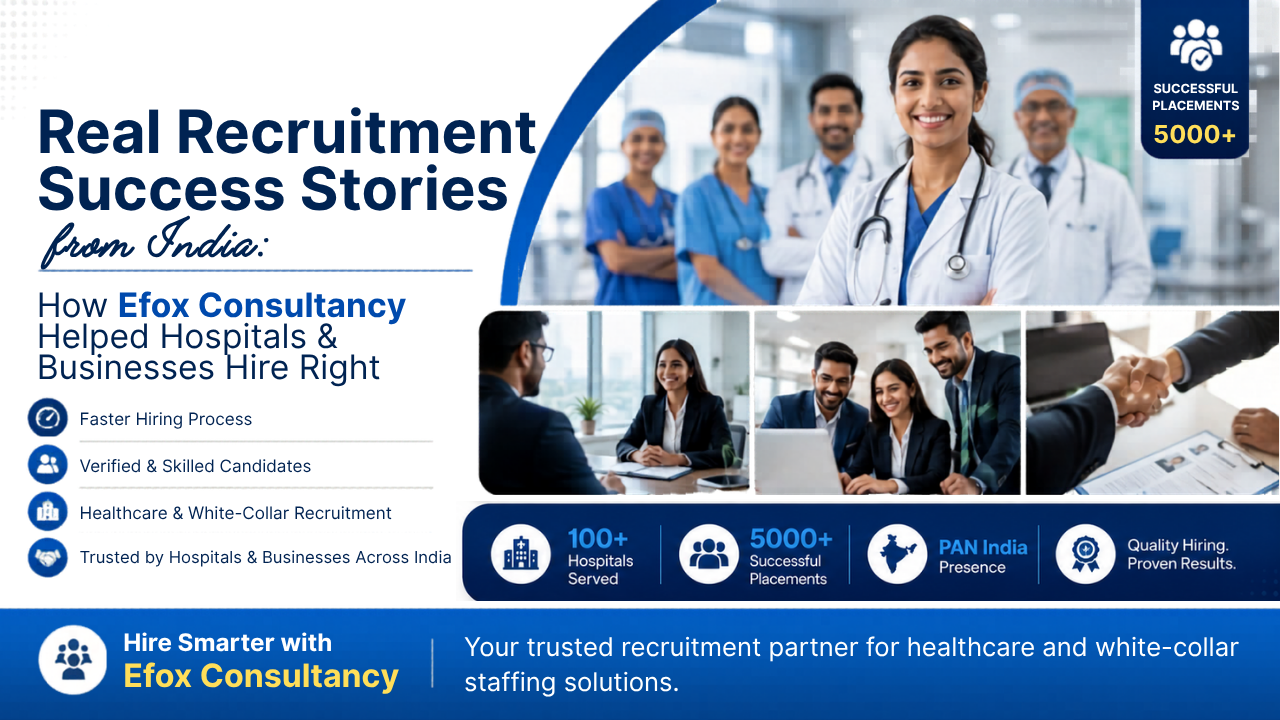
  • Real Recruitment Success Stories from India: How Efox Consultancy Helped Hospitals & Businesses Hire Right

    Real Recruitment Success Stories from India: How Efox Consultancy Helped Hospitals & Businesses Hire Right

    Picture this: a 120-bed hospital in Bareilly, operating at full OPD capacity, loses three nurses in the same week. No warnings, no handover. Just empty shifts, stretched staff, and patients waiting longer than they should. The administrator calls three agencies. One ghosts them. One sends CVs of people who don’t match the role at all. The third—Efox Consultancy—has two shortlisted candidates in front of them within 72 hours.

    That’s not a highlight reel moment we invented for this article. That’s the kind of thing that happens regularly when recruitment success stories in India are actually built on process, not promises.

    Hospitals, clinics, and businesses across Uttar Pradesh and beyond deal with hiring pressure that’s constant, unpredictable, and often urgent. The right hire keeps operations running; the wrong one — or worse, the unfilled seat — costs far more than money. What follows are anonymized case studies drawn from real engagements at Efox Consultancy. Names and identifying details have been changed, but the situations, challenges, and outcomes are real.

    If you’re wondering whether a consultancy can actually deliver in your sector, these stories are your answer.

    Recruitment Success Stories India: The Hospital That Couldn’t Keep Nursing Staff

    A 150-bed multi-speciality hospital in Western UP came to Efox with a recurring problem. They weren’t struggling to hire nurses — they’d hired plenty. The issue was retention. GNM-qualified staff would join, serve three to four months, and leave for better-paying positions in metro cities or private diagnostic chains.

    The hospital’s HR head was frustrated. She wasn’t looking for a recruitment agency that could send 50 profiles. She needed someone who would understand why staff were leaving—and then source people who actually wanted to stay.

    What the Efox team did differently

    Instead of immediately pushing profiles, the consultancy team spent time understanding the hospital’s pay band, the working environment, the shift structure, and the geography of where the nursing staff was likely coming from. Candidates sourced from nearby districts—Shahjahanpur, Pilibhit, and Rampur—typically had lower migration risk than those from metros.

    Within three weeks, six GNM nurses and two BSc nurses were placed. All eight had verifiable local roots, realistic salary expectations, and clear long-term intent. Fourteen months later, the hospital reports that seven of the eight are still in their roles. That’s a retention rate that their internal hiring had never achieved.

    Their hospital staffing solutions approach is built around exactly this kind of contextual thinking—not just filling a vacancy, but filling it with someone who’ll actually stay.

    Placement Success Story: A Clinic That Needed a Duty Doctor in 10 Days

    A private clinic group with three centers in Bareilly had a medical officer resign with very little notice. For a facility running daily OPD, even a week without a duty doctor creates real problems: patient trust erodes, OPD revenue falls, and remaining staff get overburdened.

    The clinic’s owner was skeptical about using a consultancy. His previous experience had involved being sent profiles of doctors who were either overqualified, unavailable, or had already accepted other offers. He reached out to Efox Consultancy half-expecting the same outcome.

    How this placement success story unfolded

    The Efox team verified the role requirements carefully: MBBS, minimum two years post-internship experience, willingness to handle OPD and emergency cover, and availability within 10 days. They ran a focused sourcing process, leaning on their active candidate database and medical job platforms.

    Three shortlisted profiles were sent within four days. All three were genuinely available; all three had verified credentials. The clinic conducted interviews on day five and six. An offer was extended on day seven. The doctor joined on day ten.

    The clinic owner later mentioned that what impressed him wasn’t just the speed—it was that every candidate presented was actually real. No filler CVs, no time-wasters.

    Efox’s doctor staffing solutions service operates with the same focused approach—credibility, availability alignment, and realistic timelines.

    Staffing Case Studies India: White Collar Hiring That Went Right

    Not every story here is from the healthcare sector. A trading company in Moradabad needed a senior accounts executive who understood Tally, GST compliance, and could handle reconciliation independently—without needing six months of hand-holding. They’d tried Naukri.com, tried referrals, tried a local consultant. Nothing had stuck.

    The problem? Everyone who applied either lacked the compliance experience or had inflated salary expectations the company couldn’t match.

    Finding the right fit, not just the available candidate

    Efox’s white collar team does something that job portals can’t: they screen for intent, not just skills. A candidate might have the perfect Tally experience but be actively looking to jump industries. That’s not a fit. Another might have slightly less experience but be stable, motivated, and willing to grow with the company.

    Two weeks after the briefing, the company interviewed three candidates. One was selected. Three months in, they promoted him to handle their second branch’s accounts too. That’s a placement success story that no portal algorithm would have predicted.

    Their white collar staffing services cover administration, finance, HR, and operations roles—with the same structured screening process applied to healthcare.

    Hospital Hiring Success India: ICU and OT Staffing for a Growing Facility

    One of the more challenging recruitment success stories India has to offer involves a fast-expanding surgical hospital in Lucknow. They were adding a new modular OT and needed both OT technicians and a scrub nurse who could handle specialized instrument protocols. These aren’t easy profiles. Candidates with the right clinical background and OT experience are genuinely rare, and the few who have it are often already employed.

    The hospital had been searching for three months before reaching Efox. Their HR team had approached seven candidates through various channels — two never responded to follow-ups, three wanted salaries significantly above the band, and two had experience that looked right on paper but turned out to be from low-volume facilities.

    Structured sourcing for specialised roles

    Efox’s healthcare team treated this differently from a standard nursing vacancy. They mapped the candidate profiles required by OT type, instrument familiarity, and patient volume capacity. They ran outreach specifically through clinical professional networks, not just job boards.

    Within three weeks, they presented four candidates. Two were selected. Both had verifiable OT experience at facilities with comparable volume. Both joined within the month. The hospital’s new OT launched on schedule.

    This particular engagement led to the hospital making Efox their primary staffing partner for all future clinical hires—which is perhaps the clearest signal of trust you can get.

    What Makes These Recruitment Success Stories in India Repeatable?

    You might be thinking, “Okay, these are good outcomes, but what’s the actual framework behind them?” That’s the right question.

    A single good hire is luck. A pattern of good hires is a process. Here’s what consistently separates the placements that stick from the ones that don’t.

    • Role clarity before sourcing begins — Efox spends real time understanding the environment the candidate will be walking into, not just the job description on a form.
    • Candidate honesty over candidate quantity — fewer profiles, but each one is real, available, and genuinely interested in the role.
    • Geography-aware sourcing — especially for healthcare, where local roots significantly affect retention.
    • Post-placement follow-up — the relationship doesn’t end when the offer letter is signed.
    • Sector specialization — the healthcare team understands clinical roles; the white-collar team understands business functions. There’s no generalized ‘recruitment’ approach applied everywhere.

    You can read more about their structured recruitment approach on the Efox Consultancy.

    Staffing Case Studies India: What Clients Tell Us After the First Placement

    The feedback from clients after their first engagement with Efox consistently centers on a few themes. Not ‘wow, that was fast’ — though speed is often relevant. It’s more like, ‘That candidate actually understood the role,’ and ‘We didn’t waste time on irrelevant interviews.’

    A hospital administrator from Muzaffarnagar put it plainly: her team used to dread recruitment drives because they’d spend entire afternoons interviewing people who shouldn’t have been shortlisted in the first place. After working with Efox, they interview two or three candidates and hire from that pool.

    A business owner from Agra, who used Efox for front office hiring, noted that the candidate they placed stayed through a period of business uncertainty when most of his staff were making moves elsewhere. He credits the initial fit assessment for that.

    These aren’t remarkable stories because the hires were perfect from day one. They’re remarkable because the right effort was put in at the front end, which is exactly where most hiring processes fall apart.

    To see what Efox Consultancy has documented about their placement outcomes, visit their recruitment success stories.

    Frequently Asked Questions About Recruitment Success Stories India

    Q1. What types of organizations can benefit from Efox Consultancy’s staffing services?

    Efox primarily serves hospitals, clinics, diagnostic centers, and white-collar businesses across Uttar Pradesh and other Indian cities. Their core strength is healthcare staffing—nurses, paramedical staff, duty doctors, and OT specialists—but they also support office-based organizations needing accounts, administration, HR, and operations professionals. Both small multispecialty clinics and larger 150+ bed hospitals have worked with them successfully.

    Q2. How long does it typically take to receive shortlisted candidates?

    For most standard roles, Efox shares an initial shortlist within five to seven working days. For urgent requirements—particularly in healthcare, where patient care can be directly affected—they can often mobilize faster, sometimes within 48 to 72 hours. Timelines depend on role specificity, geographic location, and candidate availability, but the team is transparent about what’s realistic from day one.

    Q3. Are the recruitment success stories India shared on this blog real placements?

    Yes. All case studies on this blog are based on actual engagements handled by Efox Consultancy. Names, specific locations, and identifying details have been anonymized to protect client confidentiality and candidate privacy, but the problems, approaches, and outcomes described are accurate. This is not a marketing exercise — these are documented placement histories.

    Q4. What sectors does Efox Consultancy focus on for hospital hiring success in India?

    Healthcare is their primary sector, with deep experience in hospital staffing across clinical and non-clinical roles. On the clinical side, this includes GNM and BSc nurses, ICU and OT specialists, paramedical staff, and duty doctors. On the non-clinical side, they handle hospital administration, billing, front desk, and support roles. For non-healthcare businesses, they handle white-collar staffing across industries in Western UP and beyond.

    Q5. How does Efox ensure candidates don’t leave shortly after joining?

    Their approach specifically addresses retention risk at the sourcing stage — not after a candidate resigns. This involves geographic screening (sourcing from areas where candidates have local roots and fewer reasons to relocate), realistic expectation-setting on both sides, and post-placement follow-up to catch early friction before it becomes a departure. The retention outcomes seen in their hospital engagements are a direct result of this front-loaded effort.

    Q6. Can Efox handle bulk or urgent hiring requirements?

    Yes, they can support both urgent single-position requirements and bulk hiring drives, though they emphasize that speed should not come at the cost of fit. For urgent needs—a hospital needing a duty doctor in under two weeks, for instance—they have a well-maintained active candidate pipeline that allows for faster turnaround without compromising on credential verification and experience assessment.

    The Proof Is in the Placement

    Hiring is one of those things that looks simple until it isn’t. Any agency can send you CVs. Any platform can surface profiles. What’s actually hard — and genuinely rare — is a consultancy that understands why a hire needs to work, not just whether a candidate ticks boxes on a form.

    The recruitment success stories India featured here share something important: in every case, the right outcome came from doing the unglamorous work up front. Understanding retention risk. Verifying credentials properly. Knowing when a candidate is available versus when they’re just testing the market. These aren’t flashy approaches. They’re disciplined ones.

    Hospitals across UP—from Bareilly to Lucknow to Muzaffarnagar—have found that working with Efox Consultancy means fewer wasted interview rounds, better-fitting candidates, and meaningfully higher retention. Businesses in manufacturing, trading, and services have found the same. That pattern doesn’t emerge from luck. It emerges from a recruitment process that takes the requirement seriously from day one.

    If your organization is dealing with a hiring challenge that feels harder than it should be—whether it’s an urgent clinical vacancy, a difficult-to-fill specialist role, or a white-collar position you’ve tried to fill twice already—Efox Consultancy is worth a conversation. Not a pitch. A conversation about whether they can genuinely help.

    Start that conversation at efoxconsultancy.com, or reach out directly through their contact page. The right hire is worth getting right.

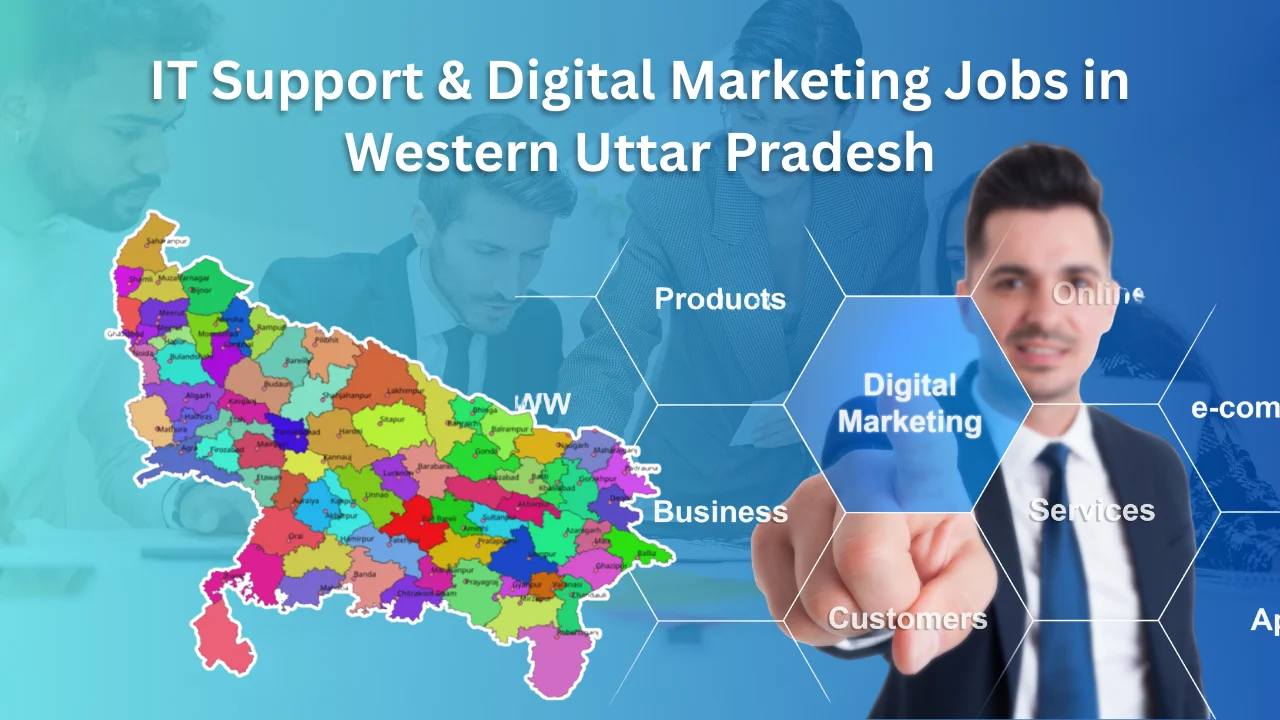
  • IT Support & Digital Marketing Jobs in Western Uttar Pradesh

    IT Support & Digital Marketing Jobs in Western Uttar Pradesh

    Career Opportunities in Noida, Bareilly, Meerut, Lucknow & Nearby Cities

    The digital revolution has transformed the employment landscape across India, and Western Uttar Pradesh is no exception. Once considered limited to traditional industries, this region is now witnessing rapid growth in IT support, digital marketing, technical services, and online business operations.

    Cities such as Bareilly, Shahjahanpur, Pilibhit, Aligarh, Budaun, Rampur, Moradabad, Bulandshahr, Noida, Lucknow, and Meerut are seeing a steady rise in demand for skilled professionals in IT and digital fields. From small businesses going online to hospitals, schools, and corporate offices adopting digital systems, companies now actively hire trained candidates for technical and digital roles.

    This blog explains why IT support and digital marketing jobs are among the best career options, what roles are available, and how candidates in Western UP can build strong careers in this fast-growing sector.

    📢 For the latest job updates, join our broadcast channel: Click Here

    Why IT & Digital Marketing Jobs Are Growing in Western UP

    The demand for IT and digital professionals is increasing due to several major changes:

    • Businesses shifting to online platforms
    • Increased use of digital payments and CRM software
    • Growth of e-commerce and online services
    • Expansion of startups and IT-enabled companies
    • Rising importance of social media marketing

    Even small local businesses in cities like Bareilly, Moradabad, and Rampur now need:

    • Website management
    • Social media promotion
    • Customer database systems
    • Online advertising

    This means IT and digital jobs are no longer limited to metro cities.

    📢 For the latest job updates, join our broadcast channel: Click Here

    Best Cities for IT & Digital Jobs in Western Uttar Pradesh

    IT Jobs in Bareilly, Shahjahanpur & Pilibhit

    These cities are rapidly adopting digital tools across industries.

    Common opportunities:

    • Computer operator jobs
    • IT support executive roles
    • Website management support
    • Data entry & MIS executive roles

    Search trends include:
    IT job in Bareilly, computer job in Shahjahanpur, digital job in Pilibhit

    Digital Marketing Jobs in Aligarh, Budaun & Rampur

    Local businesses are hiring digital professionals to manage online marketing.

    In-demand roles:

    • Social media executive
    • SEO executive
    • Content assistant
    • Digital promotion executive
    • Online campaign coordinator

    These roles are ideal for candidates seeking skill-based jobs near home.

    IT Support Jobs in Moradabad & Bulandshahr

    Manufacturing units, hospitals, schools, and offices require technical support staff.

    Common roles:

    • System support executive
    • Network assistant
    • Technical coordinator
    • Software support staff
    • Hardware support technician

    These cities offer stable technical jobs with steady salaries.

    Corporate IT & Digital Jobs in Noida, Lucknow & Meerut

    These cities provide the highest growth potential and salary packages.

    Top opportunities:

    • IT helpdesk executive
    • Junior software tester
    • Digital marketing executive
    • Paid ads specialist
    • CRM support analyst
    • Website & analytics executive

    Noida especially is a major hub for IT companies, startups, digital agencies, and corporate offices.

    📢 For the latest job updates, join our broadcast channel: Click Here

    Popular IT Support Job Roles

    1. IT Support Executive

    Handles:

    • Computer troubleshooting
    • Software installation
    • Network issues
    • System maintenance

    This role is ideal for candidates with basic technical training or computer courses.

    2. MIS & Data Support Executive

    Responsible for:

    • Managing data sheets
    • Reports and dashboards
    • System entries
    • Data accuracy checks

    Highly demanded in schools, hospitals, and corporate offices.

    3. Technical Coordinator

    Works with:

    • Internal teams
    • Software vendors
    • Hardware service providers

    This role requires strong coordination and problem-solving skills.

    Popular Digital Marketing Job Roles

    1. Digital Marketing Executive

    Manages:

    • Online promotions
    • Ad campaigns
    • Website updates
    • Lead generation

    Suitable for freshers with digital marketing training.

    2. SEO & Social Media Executive

    Handles:

    • Google ranking
    • Social media pages
    • Content optimization
    • Audience engagement

    High demand in Noida, Lucknow, and Meerut.

    3. Performance Marketing Assistant

    Works on:

    • Paid ads
    • Campaign tracking
    • Data analysis
    • ROI reports

    These roles offer fast salary growth and career progression.

    Skills Required for IT & Digital Jobs

    Candidates with these skills get hired faster:

    Technical Skills:

    • Basic computer operations
    • Internet tools
    • MS Office
    • Software handling
    • CRM tools

    Digital Skills:

    • Social media marketing
    • SEO basics
    • Content posting
    • Analytics understanding
    • Online ad platforms

    Short-term certifications in IT support or digital marketing significantly improve job opportunities.

    📢 For the latest job updates, join our broadcast channel: Click Here

    Career Growth in IT & Digital Fields

    IT and digital marketing offer some of the fastest career growth paths.

    Typical growth ladder:
    Executive → Senior Executive → Specialist → Manager → Consultant

    Unlike traditional jobs, these fields provide:

    • Faster promotions
    • Higher salary increments
    • Freelancing opportunities
    • Remote work options
    • International career scope

    Why IT & Digital Jobs Are Ideal for Western UP Candidates

    Professionals in Western UP prefer IT and digital roles because they offer:

    • Skill-based hiring (degree not mandatory)
    • Work-from-home opportunities
    • High demand across industries
    • Fast career growth
    • Jobs available locally and nationally

    Even candidates from small towns like Pilibhit, Budaun, or Rampur can work for companies based in Noida or other cities.

    📢 For the latest job updates, join our broadcast channel: Click Here

    How Placement Consultancies Help Candidates Get IT Jobs

    Many candidates face problems such as:

    • Not knowing where real jobs are available
    • Applying to fake online vacancies
    • Lack of interview preparation
    • Choosing wrong career paths

    Professional placement consultancies help by:

    • Providing verified job openings
    • Matching skills with suitable roles
    • Preparing candidates for interviews
    • Offering city-wise job options

    Efox Consultancy Services helps candidates secure reliable IT support and digital marketing jobs across Western Uttar Pradesh.

    📢 For the latest job updates, join our broadcast channel: Click Here

    Future Scope of IT & Digital Careers in Western UP

    The future is strongly digital. Every sector now depends on technology:

    • Education
    • Healthcare
    • Retail
    • Banking
    • Logistics
    • Manufacturing

    This ensures long-term demand for IT and digital professionals in Bareilly, Moradabad, Noida, Meerut, Lucknow, and nearby cities.

    📢 For the latest job updates, join our broadcast channel: Click Here

    Final Thoughts

    IT support and digital marketing jobs in Bareilly, Shahjahanpur, Pilibhit, Aligarh, Budaun, Rampur, Moradabad, Bulandshahr, Noida, Lucknow, and Meerut offer some of the best career opportunities for modern job seekers.

    These fields combine:

    • High demand
    • Strong growth
    • Flexible career paths
    • Skill-based entry

    For graduates and freshers looking for future-ready careers, IT and digital roles are among the smartest career choices in Western Uttar Pradesh today.

    📢 For the latest job updates, join our broadcast channel: Click Here